
Editorial Staff | XcruitEnergy | Friday, July 17, 2026 | 12:00 PM UTC
In late June 2026, Mediterranean Shipping Company — the world's largest container line — agreed to pay close to $1.4 billion for a 49% stake in a port that didn't exist eighteen months ago. That single transaction, the largest foreign private investment ever made in Indian port infrastructure, is worth pausing on. It is not speculative capital chasing a story. MSC moves more containers than any company on earth, and it just placed one of its biggest bets on a stretch of Kerala coastline called Vizhinjam.
Now a second, equally telling signal has arrived. In mid-July, barely two weeks after the MSC deal became public, Kerala's chief minister confirmed that Tata Group – the $180 billion conglomerate – has sought approval for a $1 billion shipbuilding investment in the state, with land earmarked near Vizhinjam and Kochi. It would mark Tata's first-ever entry into commercial shipbuilding.
Two of India's most consequential corporate names and the world's largest shipping line have now converged on the same fifteen-kilometre stretch of Kerala coastline inside a single month. Global investors watching India's infrastructure story from the sidelines should treat that as a pattern, not a coincidence.
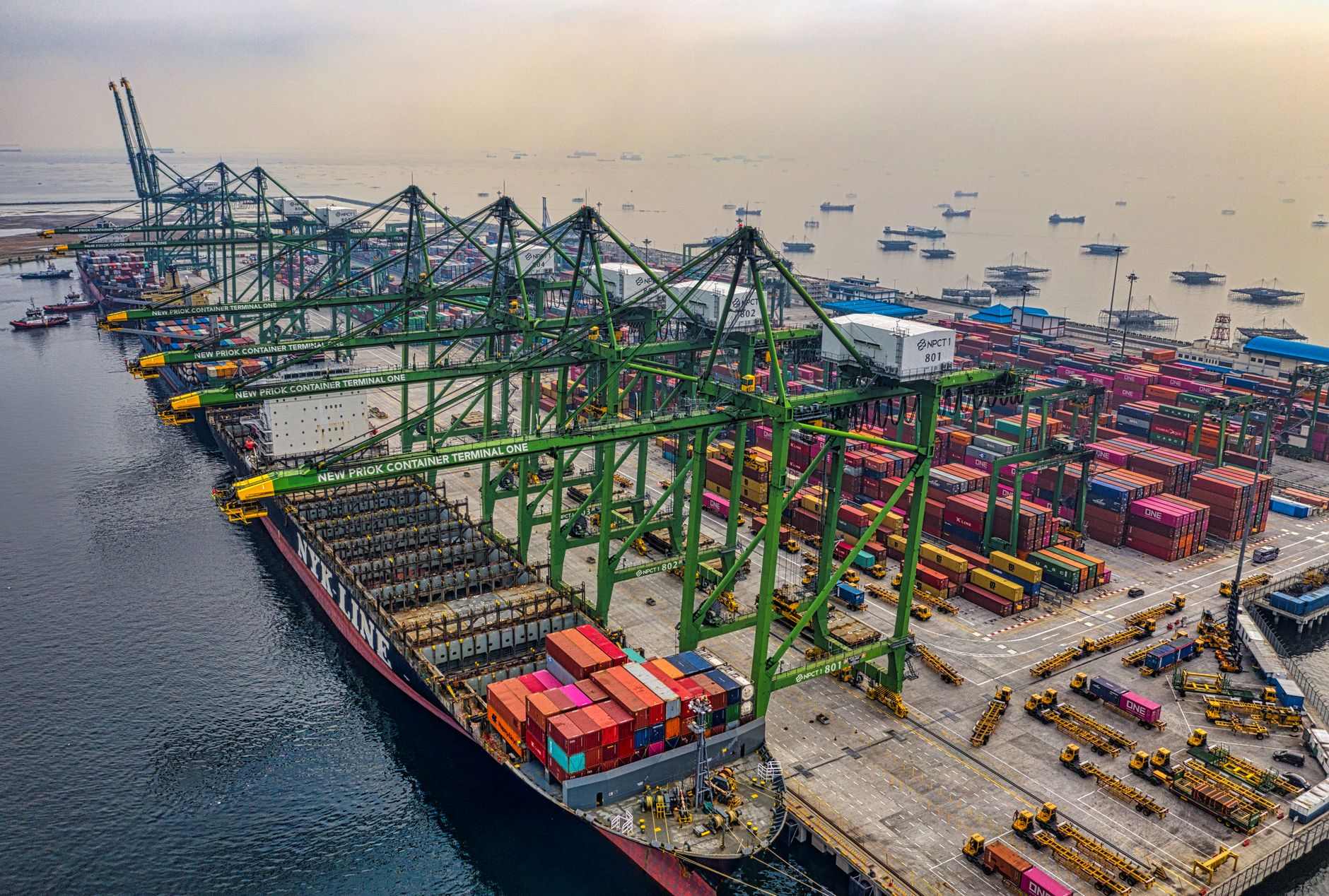
 Wide view of container ships and cranes, [Photo by Wolfgang Weiser]
A port built where geography does the work
Most Indian ports have spent decades fighting their location – shallow water requiring constant dredging, long detours from the main shipping lanes, silting that eats into every efficiency gain. Vizhinjam was built where none of that applies. It sits barely ten nautical miles from the East–West shipping corridor that carries trade between Europe, the Middle East and the Far East — the same corridor that has made Colombo, Singapore and Jebel Ali indispensable transshipment hubs for container lines that never actually call at those countries' domestic ports. Vizhinjam has a natural draft of 18–20 metres, deep enough to berth the largest container ships afloat without the capital dredging that inflates the cost base of most new port projects. It has already hosted the MSC Irina, the world's largest container vessel, and the MSC Verona, among the deepest-draft ships ever to call at an Indian port.
That is the geography. The performance since commissioning is what turns geography into an investment case. Vizhinjam went from trial operations in mid-2024 to two million TEUs (twenty-foot equivalent units – the standard measure of container volume) handled within eighteen months – the fastest ramp-up of any Indian port in history. It has processed close to a thousand vessels, including more than sixty ultra-large container vessels each running nearly 400 metres in length. Numbers like that do not happen because a government inaugurated a facility. They happen because shipping lines are actively rerouting cargo toward it.
Why this matters beyond one port
For decades, a meaningful share of India's own export and import containers has been trucked or shipped to Colombo, Singapore or Dubai for transshipment onto mainline vessels — a detour that costs Indian exporters time, money and competitiveness every single year. Vizhinjam is the first Indian port genuinely built to end that arrangement. Every container that transships at Vizhinjam instead of Colombo is foreign exchange retained onshore, a job created in logistics and ancillary services, and a data point in India's broader ambition to become a serious node in global maritime trade rather than a hinterland feeding someone else's port.
The timing compounds the opportunity. Shipping lines are currently rethinking route resilience across the board, as tensions in West Asia and repeated disruption around the Strait of Hormuz have made single-corridor dependency look like a liability rather than an efficiency. A deep-water port on India's southern tip, outside the most contested chokepoints and positioned on a major East–West artery, is exactly the kind of asset that global carriers now want in their network — not as a nice-to-have, but as insurance.
What investors are actually being offered
The Adani Group holds the 40-year concession to build and operate Vizhinjam, with the Kerala government as landlord and initial majority financier. MSC's Terminal Investment Limited arm is now buying into 49% of the operating company at a $2.85 billion enterprise valuation – a figure that says more about where sophisticated capital thinks this asset is headed than any government press release could. A $1.9 billion Phase 2 expansion is already underway, targeting capacity growth from 1.6 million to 5.7 million TEUs by 2028, alongside a planned rail tunnel connection and a dedicated cruise terminal aimed at Kerala's tourism economy.
This is, in other words, not a single-asset bet. It is early-stage exposure to an entire logistics corridor: port operations, rail and road connectivity now being built out to feed it, warehousing and bonded logistics parks that inevitably cluster around a transshipment hub of this scale, ship repair and bunkering services, and a cruise tourism vertical that barely exists yet. Each of those is a separate, investable layer sitting on top of the same underlying geography.
Enter Tata: the ecosystem thickens
The MSC deal was a bet on Vizhinjam as a transshipment node. Tata's move is a bet on something broader – that a genuine maritime-industrial cluster is forming around it. Kerala has been explicit that it wants to capture more of the maritime value chain, not just port throughput, and is actively courting shipbuilding, repair and ancillary services around Vizhinjam and Kochi. Tata Steel already supplies specialised, high-strength steel grades to shipyards; a Tata-built commercial yard sited near Vizhinjam would close the loop between domestic steel production, shipbuilding, and a deep-water port capable of servicing the largest vessels afloat – an integration few countries can offer in one geography.
This also lands inside a larger national push. New Delhi has stood up a $2.9 billion maritime development fund and set a public target of reaching the world's top five shipbuilding nations by 2047 – a considerable climb from India's current global market share of roughly 1%, in a field dominated by China, South Korea and Japan. South Korea's HD Hyundai has already committed to a roughly $4.4 billion shipbuilding hub in Tamil Nadu's Thoothukudi. Tata's proposal, still awaiting formal state clearance expected within a month, would be the first major domestic conglomerate to answer that call at scale – and it chose to do so within sight of Vizhinjam rather than at an established shipbuilding centre elsewhere in India.
For investors, the read-through is straightforward: when a port operator, the world's largest shipping line, and a first-time entrant into an entirely adjacent industry all place capital in the same small radius within weeks of each other, that is no longer a single-asset story. It is early evidence of cluster formation – the same dynamic that turned Rotterdam, Busan and Singapore from ports into economies. Vizhinjam is not just accumulating cargo volume; it is starting to accumulate industrial gravity.
 Cargo vessel moored at Kochi, Kerala, India, showcasing global container shipping, [Photo by Ankit Bhattacharjee]
The honest caveats
The MSC stake sale has already drawn public objection from the Kerala state government, which says “it was not properly consulted” on a change to the concession structure it partly owns; an empowered state committee is now reviewing the transaction on national-security, competition and public-interest grounds before it can close. The Tata shipbuilding proposal is, for now, exactly that – a proposal, with no confirmed site, capacity or timeline, and awaiting state approval expected within a month. Both deals are reminders that India's federal, multi-stakeholder project governance can move more slowly, and more publicly, than investors used to single-jurisdiction deals may expect. Environmental and fisherfolk opposition shaped years of delay before construction even began, and remains a live constituency in how the port expands. And investors should recognise that Vizhinjam is still going head-to-head with entrenched, lower-cost incumbents – Colombo above all – that will not surrender transshipment volumes without a fight on price and turnaround time.
None of that undoes the case. It tempers it into something more realistic: this is a high-conviction, long-horizon infrastructure play, not a quick arbitrage. The kind of investor for whom Vizhinjam makes sense is the kind already comfortable underwriting Indian regulatory and political texture in exchange for genuine first-mover exposure to a scarce asset class – a natural deep-water port on a top-tier global shipping lane.
The bottom line
Ports of this quality do not get built often, and when they do, the capital that arrives early tends to look very different in outcome from the capital that arrives after the story is already obvious. MSC did not wait for Vizhinjam to prove itself over a decade; it moved after eighteen months of operational data made the direction of travel unmistakable. Tata's move, coming just weeks later and reaching well beyond port operations into shipbuilding, suggests domestic capital is reading the same signal. For global investors — infrastructure funds, terminal operators, logistics majors, and increasingly sovereign wealth vehicles looking for real assets with genuine strategic value – Vizhinjam is no longer a speculative frontier bet, and it is no longer a single-company story. It is a live, de-risking, rapidly scaling asset around which both the world's largest shipping line and one of India's largest conglomerates are now positioning simultaneously. The window for early-stage participation on comparable terms will not stay open indefinitely.
Sources
- MSC to Invest $1.4 Billion in Adani's Vizhinjam Port, Acquires 49% Stake – Logistics Insider
- Tata Group to invest $1 billion in shipbuilding in Kerala: CM Satheesan – Business Standard
- Vizhinjam Post crosses two million TEUs in 18 months.
- India aims to spend up to $3B to boost domestic maritime sector – Offshore Energy.
- MSC arm to pick up 49% in Adani's Vizhinjam port for $1.4 billion – Business Standard
- Shipping and Shipbuilding Industry, ICRA (2025)
- UNCTAD, Data Hub, “Ships built by country of building, annual (analytical)”, updated Jun 2025, https://unctadstat.unctad.org/datacentre/dataviewer/US.ShipBuilding
- MSC's $1.4 Billion Stake in Vizhinjam Port Sparks Controversy – Indexbox.
- India's Kerala state not consulted on MSC's $1.4 bln port investment, chief minister says – Reuters, 2026.
- Pinarayi Vijayan targets chief minister V D Satheesan over Adani-MSC deal, The Times of India, 2026.
- Tata Group Seeks Kerala's Approval For ₹10,000 Cr Shipbuilding Investment – Outlook Business

