
Editorial Staff | XcruitEnergy | Sunday, July 26, 2026 | 04:36 PM UTC
Originally announced in March 2026, QatarEnergy is preparing to extend its force majeure declaration on liquefied natural gas shipments through mid-October, according to Bloomberg News, which reported that buyers across Europe and Asia say they expect formal notification within weeks - on a confirmation that one of the world's most reliable LNG suppliers is bracing for a fourth straight month of disrupted deliveries as the war in the Middle East keeps the Strait of Hormuz effectively closed to safe passage.
Real Market Consequences
Force majeure is the contractual mechanism a supplier invokes when extraordinary, unavoidable circumstances make it impossible to honour delivery obligations - war, in this case, rather than a production shortfall. Qatar first notified customers in June of cancellations running through August and September. If the extension through mid-October now being prepared is confirmed, it would mark the third consecutive rollback of Qatar's export timeline since the conflict escalated, and it would land at the worst possible moment for buyers: a period when Europe and Asia are already competing for a shrinking pool of spare LNG cargoes, with summer heat lifting demand in parts of Asia even as northern-hemisphere buyers try to rebuild storage ahead of winter.
Qatar alone accounts for roughly 20% or a fifth of global LNG trade, so an extension of this length does not just squeeze a handful of contracts - it removes a meaningful share of the world's flexible supply at exactly the point buyers most need it.

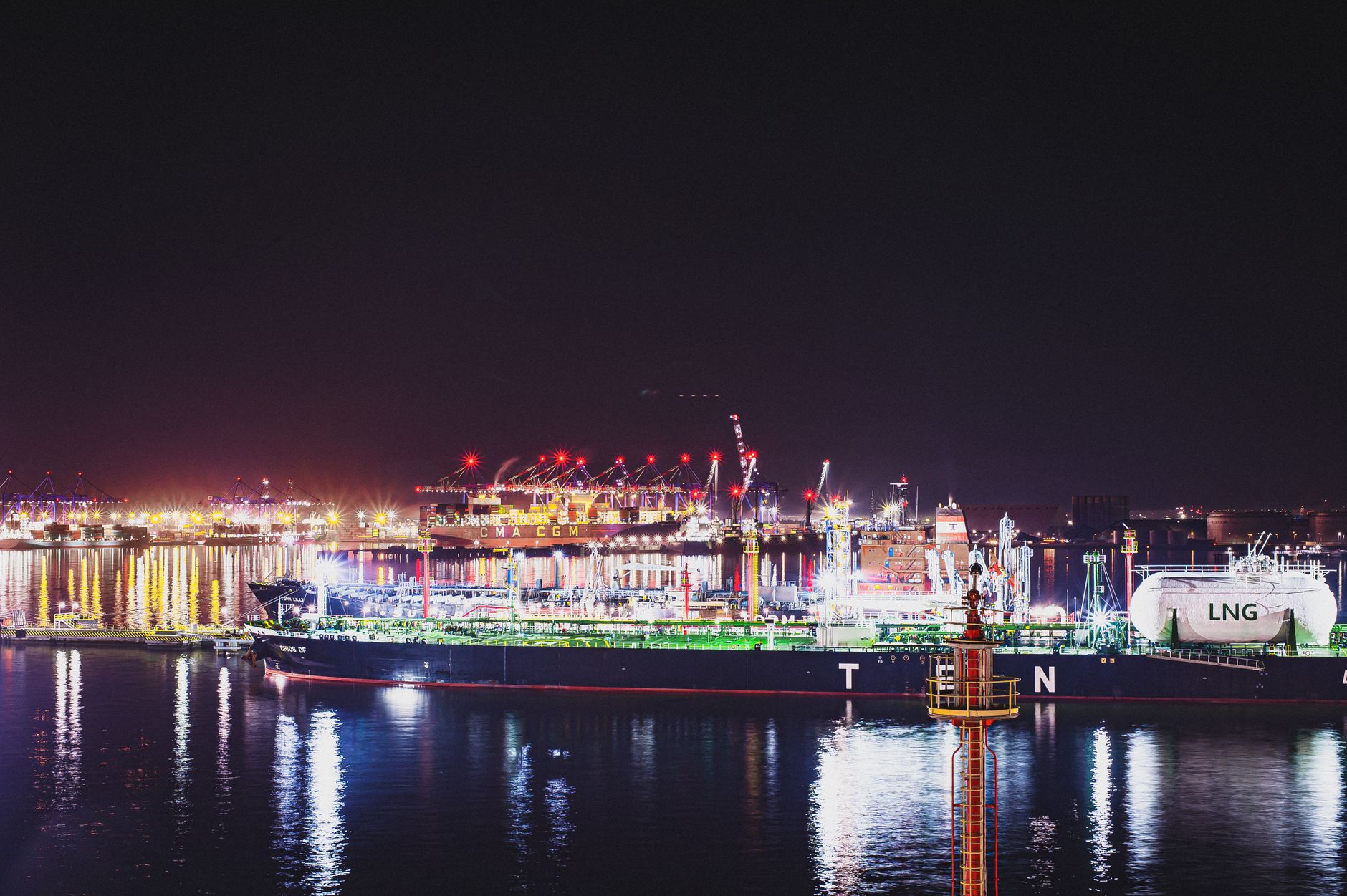
A large LNG tanker ship travels through the ocean at sunset on July 26. Edu Raw/Pexels
Asian Buyers Absorbing the Pain
The disruption isn't theoretical for Qatar's Asian customers — it's already showing up in near-term supply planning. Trade sources, including an official at Bangladesh's state gas company Petrobangla, told Reuters that QatarEnergy has separately extended force majeure notices to buyers in South Korea, India and Bangladesh, with cargoes originally due in August and early September now pushed back to at least mid-September. Petrobangla's leadership described the ongoing uncertainty as forcing the country toward costlier spot-market purchases and government-to-government arrangements with alternative suppliers, warning that a prolonged disruption would add directly to the state's energy subsidy bill.
A Weakening Freight Market, But Ships Still Finding Takers
One detail buried in the trade reporting is arguably more telling than the force majeure extension itself: QatarEnergy's marketing and trading arms, QatarEnergy LNG Marketing and QatarEnergy Trading, are continuing to lease out LNG carriers from their own fleet through October, even as freight rates for LNG vessels fall sharply in a weakening charter market. Wood Mackenzie research director Ikram Elloumi told Reuters that at least nine QELM/QET-controlled carriers have been sub-chartered to companies including Chevron, BP, EnBW, Cheniere, Kansai, SOCAR and Trafigura on short-term deals lasting 30 to 90 days. Elloumi’s read on the signal was blunt: Qatar appears to be prioritising fleet utilisation over waiting for freight rates to recover, a pattern more consistent with a company settling in for a longer disruption than one expecting an imminent return to normal export flows.

LNG carrier ship cruises. (Photo: Oleksiy Yeshtokyn/Pexels)
The Physical Risk
None of this is happening in a vacuum. Force majeure notices are Qatar's legal response to a very physical problem: getting LNG carriers safely through the Strait of Hormuz. Renewed Iranian strikes on tankers transiting the strait earlier this month, alongside news of LNG tanker hitting ship mines, have directly clouded any prospect of a near-term return to pre-war export volumes, including the attack that left a Qatari LNG tanker damaged and awaiting salvage near Hormuz earlier this month. That single incident illustrates why QatarEnergy's caution is commercial rather than merely legalistic - sending a fully loaded LNG carrier through a strait where tankers are being actively targeted is a risk few insurers or crews are willing to underwrite without a substantial premium, if at all.
Any hope of a faster resolution took a further hit this week, with the exception of the latest fresh yet fragile announcement of the US-Iran “hold” reported after US officials expressed concerns over escalating war. This comes as a turn of events after the U.S. and Iran both played down the prospect of near-term peace talks, a signal that sent both European and Asian gas prices higher. For a market that had been watching for any diplomatic opening as a cue to unwind hedges and restart normal contracting, the lack of movement effectively confirms that Qatar's extended force majeure is a rational response to a conflict with no visible end date - not an overly cautious one. Yet, this move may see quick correction depending on the seriousness of both Iran and the US.
What Buyers and GCC-Linked Businesses Should Watch
For LNG buyers, the practical takeaway is to treat mid-October as a working assumption rather than a hard deadline - Qatar has already pushed its timeline back multiple times since the conflict began, and nothing in the current diplomatic picture suggests that pattern is about to break - with the exception of the gleaming hope of the latest operations “hold” announced as of an hour ago today. For businesses across Qatar and the wider GCC tied to the energy trade - shipping, insurance, logistics and downstream industrial buyers alike - the more durable signal is the one Wood Mackenzie flagged: QatarEnergy is actively managing its fleet and contracts for a several-month disruption, not a short-term interruption. Planning assumptions across the sector should follow that lead.
Sources
- Damaged Qatari LNG tanker awaits salvage after strike near Hormuz — Reuters
- Edison: QatarEnergy Extends Force Majeure - Edison
- Hormuz Traffic Slows Amid Renewed Safety Risks - Reuters
- Iran to Halt Attacks Amid US Pause - Reuters
- Iran War Live News - CNN
- Iran War Live Updates - Al Jazeera
- Media Center News Details - QatarEnergy
- Qatar International Energy Analysis - EIA
- QatarEnergy extends LNG force majeure, charters out tankers into October, sources say — Reuters (via Zawya)
- QatarEnergy Extends LNG Force Majeure - Reuters
- QatarEnergy Halves Scheduled Deliveries to Bangladesh - Reuters
- QatarEnergy Leasing Out LNG Carriers - The Edge Malaysia
- QatarEnergy Prepares to Extend LNG Force Majeure Into October — Bloomberg
- QatarEnergy Reportedly Extending LNG Force Majeure - Yahoo Finance
- US Pauses Attacks on Iran - The Guardian

