
Editorial Staff | XcruitEnergy | Tuesday, July 28, 2026 | 12:00 PM UTC
Anthony Albanese flew to a gas town in the Pilbara this week to announce something Australia hasn't done since the 1960s: build a new oil refinery. The prime minister said Canberra and Western Australia will jointly put up A$4 million for a feasibility study, with the war in the Middle East doing most of the talking. "The longer war in the Middle East goes on the greater the impact on Australia will be," Albanese said. It's not subtle framing, and it isn't meant to be.
If it goes ahead, the refinery would be built by Perdaman, a Western Australian industrial company, at Karratha in the Pilbara - the same patch of coastline where Perdaman is already building a giant urea plant. Nothing is locked in yet. This is a study to see whether the numbers work, not a groundbreaking. But the fact that Australia is even asking the question tells you how much the last few months of Middle East conflict have rattled a country that quietly let its refining industry shrink too almost nothing.
Why Perdaman?
Perdaman isn't a random pick. It's already Canberra's partner of choice in the Pilbara - the same company is building Project Ceres nearby, a urea plant expected to produce about 2.3 million tonnes a year once it's running, backed by roughly $475 million in government loans. That project alone is projected to support 2,500 construction jobs and 200 ongoing roles once operational, with an estimated $8.5 billion in public benefit. Handing the refinery study to a company the government already has a working relationship with in the exact same town isn't a coincidence - it's a government trying to move fast by not starting from scratch.
The refinery itself, if approved, would be Australia's third, joining Brisbane and Geelong, and the first large-scale plant built in the country since the 1960s. The feasibility study is also the first agreement signed under a federal fund set aside specifically for fuel-refining studies, itself a slice of a broader $15 billion fuel security package Canberra has been building out.

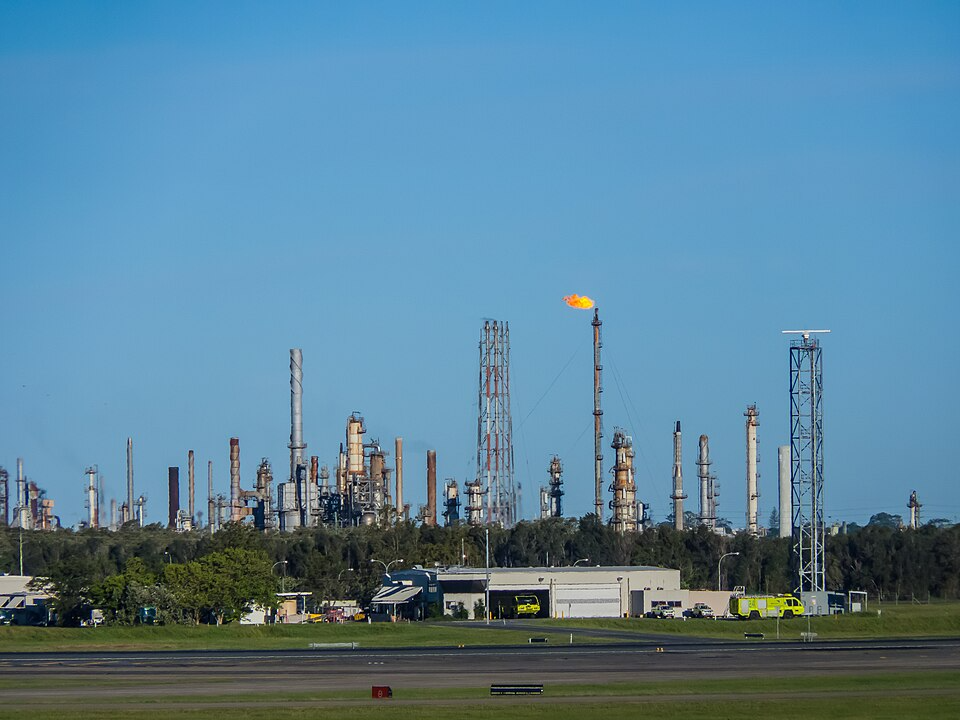
BP and Caltex oil refineries from Domestic Terminal Brisbane Airport; image by John Robert Mc Pherson [source commons: Wikimedia]
Crude that keeps, fuel that doesn't
There's a catch worth sitting with: even a brand-new Australian refinery would still run on imported crude oil. Resources Minister Madeleine King made that point directly — this isn't about drilling Australian oil, because there isn't much of it to drill. What it changes is where the vulnerability sits. Crude oil, King noted, is storable for much longer than refined fuel, which means a country holding crude reserves and doing its own refining has more runway during a supply shock than one waiting on tankers of finished diesel and petrol.
That's a genuinely different kind of energy security than "produce more oil." It's closer to insurance — the ability to keep turning stockpiled crude into usable fuel even if the ships carrying refined product stop showing up on schedule.
The caveat
This is a feasibility study, not a final investment decision. A$4 million buys you an answer to whether the project stacks up — it doesn't buy you a refinery. Site selection, cost, and timeline are all still open questions, and Albanese himself framed it as making sure "it's a project that stacks up, that can go forward," not a guarantee that it will. Refineries are also notoriously slow and expensive to build, and Australia's last one went up when oil economics looked nothing like they do now. Nothing here confirms a construction start date, a total project cost, or a completion timeline.
The bottomline: Australia spent three decades treating refining as someone else's problem to solve — cheaper to import, easier to let Asian mega refineries carry the load. A war that's made the Strait of Hormuz a liability for the whole world just put a price on that convenience. A$4 million is a small bet for a country this size, but it's the first real sign Canberra is willing to rebuild capacity it spent thirty years dismantling. Whether Perdaman's Karratha refinery actually gets built is still an open question. That Australia is asking it at all is the story.
Frequently Asked Questions
What exactly did Australia announce?
A jointly funded A$4 million feasibility study into building a new large-scale oil refinery in Western Australia Australia's first in more than 60 years.
Who would build it?
Perdaman, a Western Australian industrial company already building a urea plant, Project Ceres, in the same town of Karratha.
Why now?
The US-led war on Iran has squeezed global oil supply chains, and Australia's Treasury has warned oil markets now have weaker buffers against future shocks.
How reliant is Australia on imported fuel today?
Roughly 80% of Australia's fuel needs are met through imports.
How many refineries does Australia currently have?
Just two . Ampol's refinery in Brisbane and Viva Energy's plant in Geelong, which can process up to 120,000 barrels a day. That's down from eight in 2000.
Why does Western Australia have none at all right now?
BP closed its Kwinana refinery, WA's last one, in 2021.
Would the new refinery reduce Australia's dependence on foreign oil entirely?
No.Resources Minister Madeleine King has been clear the refinery would still rely on imported crude oil. The benefit is that crude is easier to stockpile than refined fuel.
Is construction guaranteed to go ahead?
No.This is a pre-feasibility study only. Albanese said the goal is to confirm the project stacks up before anything is committed.
What would this refinery's place be among Australia's refineries?
It would be Australia's third refinery, and the first large-scale one built since the 1960s.
Is this part of a larger government program?
Yes. It's the first agreement signed under a federal fund for fuel-refining feasibility studies, part of a broader $15 billion fuel security package.
Sources
• Australia considers first domestic oil refinery in 60 years — The Jakarta Post, July 28, 2026
• Third oil refinery would still rely on imported oil — AAP via Port Macquarie News, July 2026
• Australia: New oil refinery study addresses global fuel shocks — AAP via The Land, July 2026
• Third oil refinery on cards to help 'shield Australia' — AAP News, July 2026

